Some things I've built or am building.
NSERC-funded research in representation theory and computational algebra. Starting May.
Summer 2026. In progress.Designed and built the public site for Queen's Undergraduate Business & Engineering club. qubequeens.com.
HTML, CSS. March 2026.Simulates Toronto subway delays using Monte Carlo methods to estimate commute time distributions across different routes and times of day. Uses historical delay data from the TTC's open data portal. GitHub. ttcmontecarlo.vercel.app.
Python, NumPy, pandas, Streamlit. February 2026 - present.Multi-agent consensus system modelled after how hedge funds use satellite imagery of retail parking lots to predict quarterly earnings (APSC 200, Queen's). 500+ simulated agents fuse noisy data into trading signals using a Graph Laplacian consensus algorithm. Each agent communicates only with spatial neighbors and iteratively converges to the true network average. Reduced simulated processing from 1.4 hours to 0.68 seconds. Achieved convergence error of 2.84 × 10⁻¹⁴ (eight orders of magnitude beyond target). Maintained accuracy with 20% node failure.
MATLAB, Python, Graph Laplacian consensus. Fall 2025.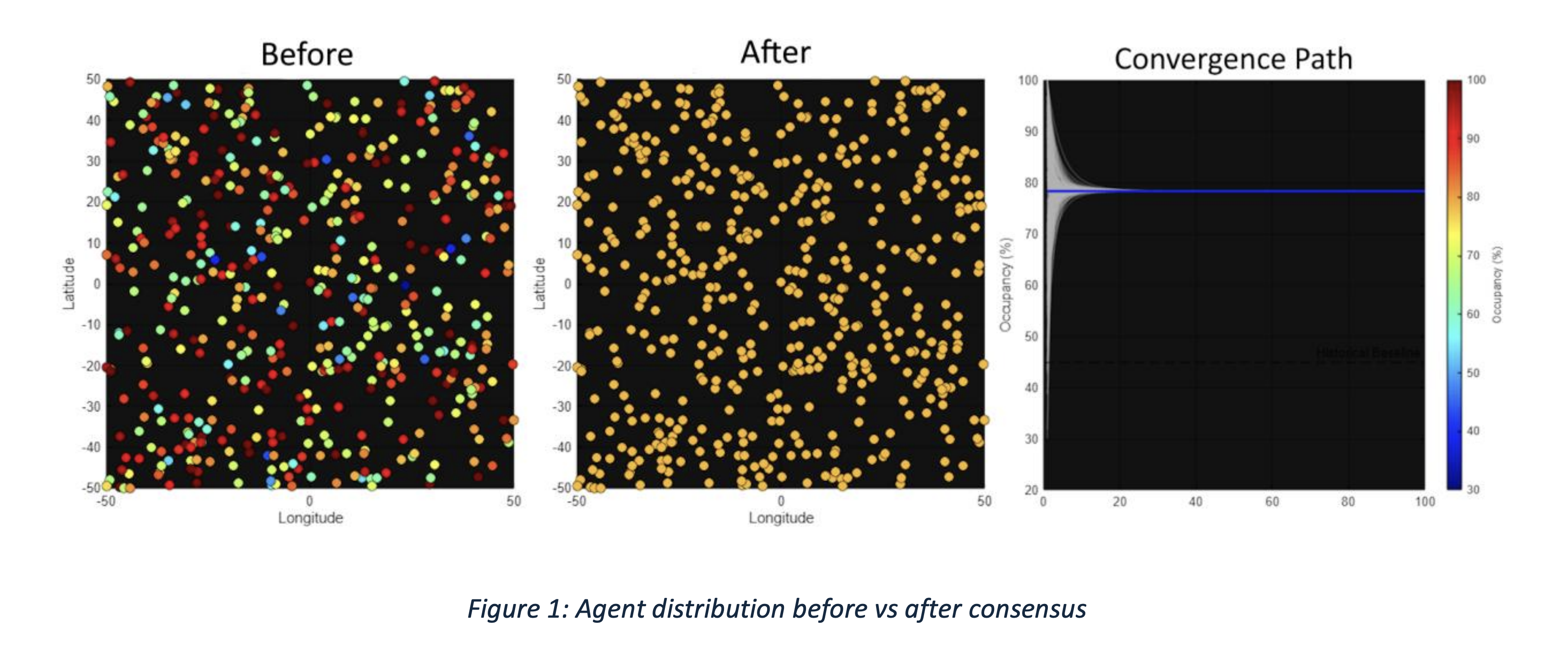
Full-stack scheduling system built for a real children's science camp (APSC 103, Queen's). Replaced a manual spreadsheet workflow with an automated constraint-satisfaction engine that handles instructor-to-camp assignments, break optimization, and regulatory ratio compliance across every 15-minute time block. The core is a multi-step scheduling pipeline: availability filtering, demand calculation based on enrollment and age-group ratios (1:6 junior, 1:8 senior), floater reservation, sequential camp filling, and staggered break optimization. 20,000 lines of code, 50+ API endpoints, 7 database tables with SQL triggers and views.
Python, Flask, SQLAlchemy, SQLite, vanilla JS, ReportLab, openpyxl. Spring 2025.Demo video
Earlier work
Survey paper covering the history of exoplanet discovery, detection methods (Doppler spectroscopy, transit-spectrometry, direct imaging), and four notable exoplanets: KELT-9b (hottest), PSR B1257+12 A (least massive), Kepler-452b (most habitable), and Proxima Centauri b (closest to Earth). Written at Harvard Summer School, 2023.
Submitted to Dr. John A. Lewis III.Paper (PDF)